Tandem OLED is Here.

If you’re anything like us, your search history is currently a graveyard of "OLED vs. Mini LED" comparisons. We get it. You’ve spent weeks on Configurine dialing in that perfect build—obsessing over airflow, cable management, and GPU clearance—only to hit the monitor wall.
For years, the choice has been a stressful trade-off: Do you buy an OLED for the perfect blacks (and live in fear of your taskbar burning into the screen), or do you settle for Mini LED and tolerate the "blooming" halo effect every time you move your mouse in a dark room?
Enter Tandem OLED.
You might have heard this buzzword thrown around by Apple fans last year, or seen it in luxury car dashboards. But ignore the tablets. The tech has finally migrated to where it belongs: the PC battlestation. And honestly? It might just be the panel technology that finally makes you pull the wallet out.
What is Tandem OLED? (The "Explain Like I Build PCs" Version)
Traditional OLED panels (like the WOLEDs and QD-OLEDs of yesteryear) use a single layer of organic material to emit light. They look amazing, but they have a glass jaw: to get them bright, you have to pump a lot of voltage through that single layer, which wears it out fast. This is why "burn-in" is the boogeyman of PC gaming.
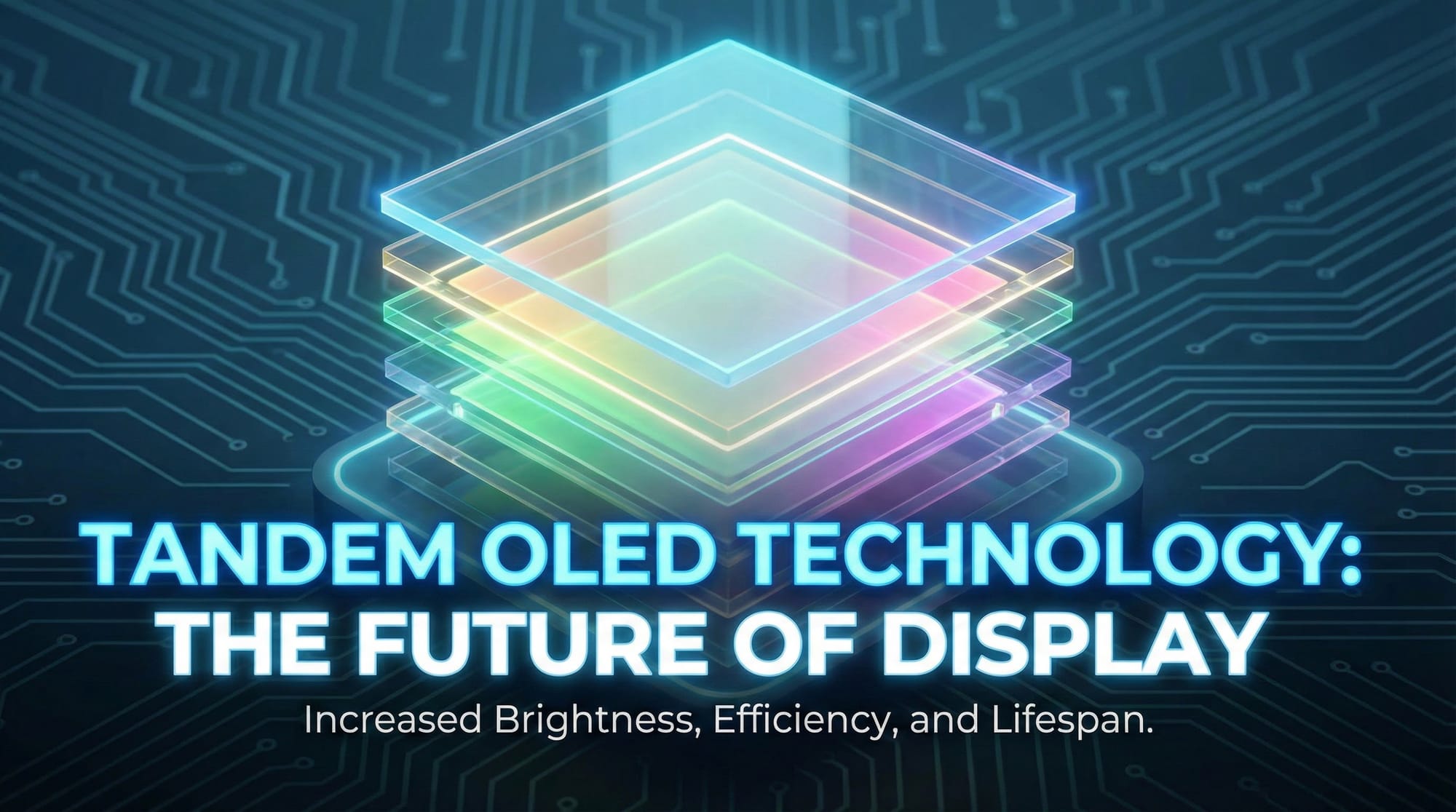
Tandem OLED solves this by physically stacking two layers of emissive organic material on top of each other.
Think of it like SLI for your pixels. By splitting the electrical load across two layers, the panel can achieve:
- Higher Brightness: We're talking 1,500+ nits peak without breaking a sweat. It finally has the horsepower to fight back against a sunlit room.
- Massively Improved Lifespan: LG Display claims a 60% to 3x improvement in longevity. Because each layer works half as hard to produce the same light, the risk of burn-in from your HUD or taskbar is significantly lower.
- Efficiency: Brighter screens that sip less power? Yes, please.
The Cage Match: Tandem vs. The World
How does this new heavyweight stack up against the current roster?
Tandem OLED vs. QD-OLED
Single-layer QD-OLED (Samsung’s quantum dot tech found in Alienware monitors) is still incredible. It arguably holds a slight edge in pure color saturation ("color volume") because of those quantum dots. However, Tandem closes the brightness gap that older WOLEDs suffered from.
- Winner: Tandem OLED for durability and brightness. QD-OLED for pure color volume in dark rooms.
Tandem OLED vs. Mini LED
Mini LED has been the go-to for brightness junkies. It gets searingly bright, but it relies on backlighting zones. That means "blooming" (halos around bright objects on dark backgrounds) is inevitable.
- Winner: Tandem OLED. It matches the brightness (1500 nits) but keeps the pixel-perfect, infinite contrast of OLED. Mini LED is officially on notice.
Tandem OLED vs. Micro LED
Micro LED is still the endgame boss. It’s inorganic (no burn-in ever), super bright, and modular. It’s also vaporware for consumers.
- Winner: Tandem OLED (by default). Unless you have the budget of a small nation-state, you aren't buying a Micro LED monitor in 2026. Tandem is the bridge to that future, available now.
When Can I Buy It? (And From Who?)
This isn't "coming soon" tech. It’s hitting the shelves as we speak.
1. The Value King: Gigabyte AORUS MO27Q28G Gigabyte has a habit of taking high-end panels and putting them in accessible packages. This model uses the new "Primary RGB Tandem" tech but targets the "sweet spot" gamer.
- Specs: 27-inch, 1440p, 280Hz.
- Why we love it: It brings Tandem durability to a price point (~$600) that actually fits into a mid-range Configurine build.
2. The Speed Demon: LG UltraGear 27GX790B LG is the primary manufacturer of these panels, so naturally, they are pushing the envelope.
- Specs: 27-inch, 1440p.
- Refresh Rate: A blistering 540Hz (with a Dual Mode that hits 720Hz).
- Target: If you are an esports pro who needs motion clarity that breaks the laws of physics, this is your stop.
3. The Glossy Option: ASUS ROG Strix XG27AQWMG Many gamers prefer a glossy coating to make colors "pop," and ASUS has delivered. This monitor pairs the Tandem panel with a "TrueBlack Glossy" coating that makes blacks look impossibly deep.
🚨 BREAKING NEWS (Dec 23, 2025): Literally today, reports are flooding in that LG Display has unveiled the world's first RGB Stripe Tandem OLED panel for monitors.
Why this matters: Most current OLEDs use a WRGB layout, which can sometimes make text look a bit fringy. RGB Stripe is the holy grail for text clarity. While the monitors available today (listed above) use the standard layout, these new RGB Stripe panels—specifically a 27-inch 4K model—are likely coming in mid-2026. If you do a lot of text work, it might be worth the wait.
Where is Alienware?
If you are browsing Configurine looking for a Dell or Alienware badge, you're currently going to find QD-OLED (like the AW2725Q). Dell is sticking with Samsung's panel tech for their monitors right now. However, if you need a laptop, the Dell XPS 13 (9350) does feature a stunning Tandem OLED screen.
The Verdict
If you are rocking a 3-year-old IPS panel, the jump to Tandem OLED will feel like a generational leap. The durability alone makes it the first OLED we can comfortably recommend for a daily driver that handles both Excel spreadsheets and Cyberpunk.
Ready to upgrade? Head over to Configurine to make sure your GPU can actually push 280Hz at 1440p—because there's no point in buying a Ferrari if you put a lawnmower engine in it.