What and when and where is CUDIMM?

f you have been browsing motherboard specifications or reading the latest JEDEC press releases, you have likely encountered the acronym CUDIMM. With the recent launch of Intel’s Arrow Lake Refresh, this new memory standard is frequently cited as a requirement for high-end builds.
However, for those of you visiting Configurine to plan your next workstation or gaming rig, you may have noticed that CUDIMM modules are not yet listed in the builder. This is intentional. Given the current component landscape, we want to provide a clear, matter-of-fact breakdown of what this technology is, why availability is sparse, and whether it is a necessary investment for your system.
What is CUDIMM?
CUDIMM stands for Clocked Unbuffered Dual In-line Memory Module.
In traditional UDIMMs (the standard RAM you have used for years), the clock signal is generated by the CPU’s memory controller and travels across the motherboard to the memory chips. As DDR5 speeds pushed past 6,400 MT/s, signal degradation over that physical distance became a stability bottleneck.
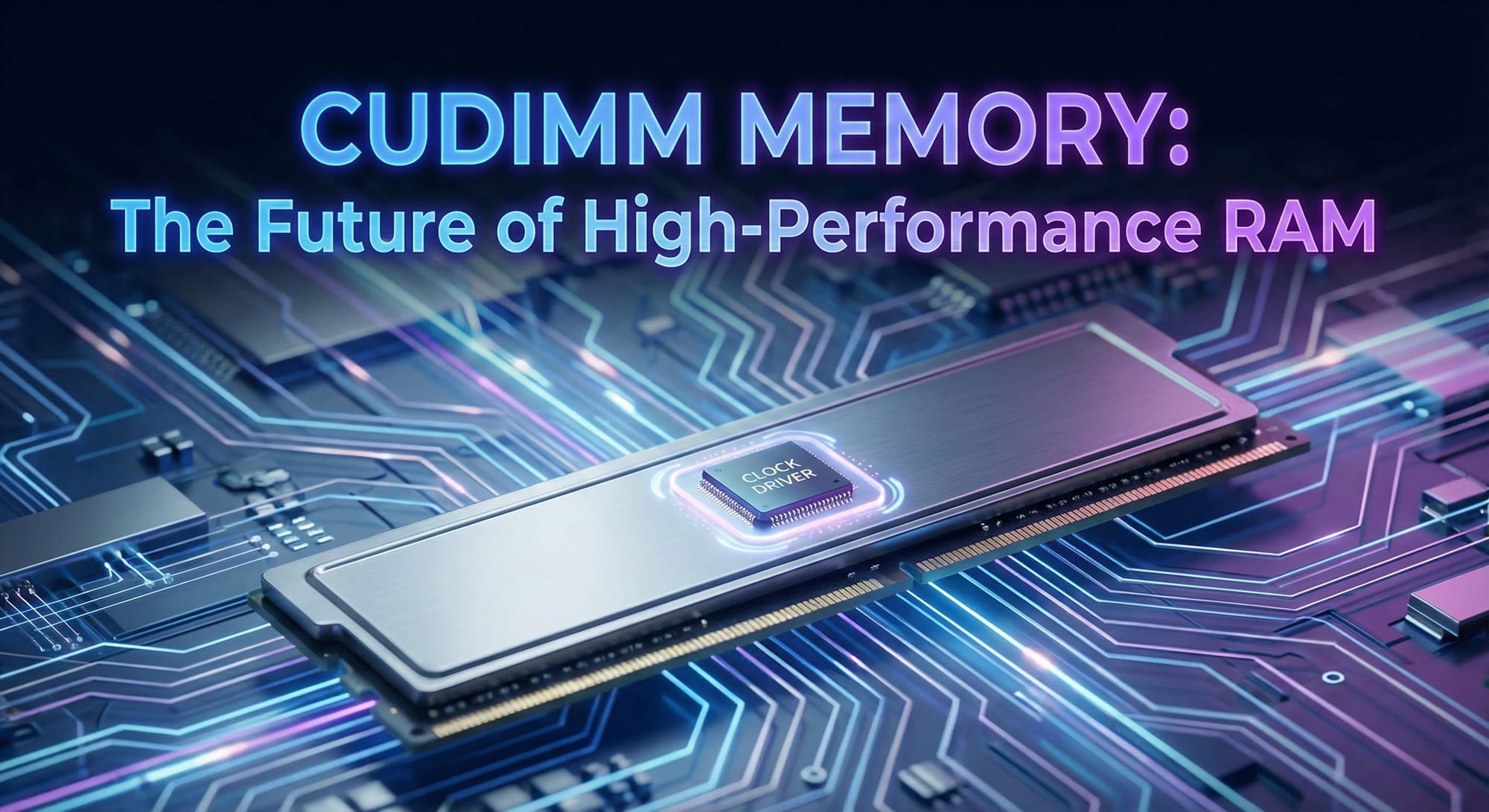
CUDIMM addresses this by integrating a Clock Driver (CKD) chip directly onto the memory module. This small chip regenerates the clock signal locally on the stick, ensuring a clean, stable signal reaches the DRAM chips. This allows for significantly higher frequencies—often exceeding 9,000 MT/s—without the errors associated with standard unbuffered DIMMs at those speeds.
The Adoption Timeline
As of late 2025, support for CUDIMM is split between platforms.
- Intel: The technology is natively supported on the LGA 1851 socket. If you are building with a Core Ultra 200S (Arrow Lake) or the newly released Arrow Lake Refresh CPUs on a Z890 motherboard, CUDIMM is the intended standard for high-frequency memory.
- AMD: Support on the AM5 platform is currently limited. While CUDIMM sticks physically fit into Ryzen 9000 series motherboards, they typically operate in "bypass mode." This effectively disables the onboard Clock Driver, causing the expensive module to function like a standard UDIMM. Full native utilization of the CKD is expected to arrive with future architecture updates.
The "AI Squeeze" on Availability
We cannot discuss memory in 2025 without addressing the supply chain. As has been widely reported, major semiconductor fabricators have reallocated significant wafer capacity to HBM (High Bandwidth Memory) to meet the demand for enterprise AI data centers.
This reallocation has constrained the supply of standard DRAM wafers. CUDIMM modules are particularly affected because they require both high-bin memory ICs and the specific CKD chips. Consequently, CUDIMM remains a low-volume, high-cost item. We do not expect it to replace standard UDIMMs in mass-market builds until supply pressures ease, likely in 2026 or 2027.
Industry Support
Despite the shortages, several manufacturers have released kits for the enthusiast market:
- Memory: G.Skill, TeamGroup, Kingston (Fury), Corsair, and ADATA have all released CUDIMM kits, though stock is often intermittent.
- Motherboards: High-end Z890 boards from ASUS, MSI, Gigabyte, and ASRock have been updated to support the clock driver handshakes required by these modules.
Advantages and Disadvantages
Advantages:
- Stability: The primary benefit is improved signal integrity, allowing for plug-and-play stability at speeds that previously required manual tuning.
- Speed: It is currently the only reliable way to run DDR5 at 9,000+ MT/s for daily driving.
Disadvantages:
- Cost: Due to the added CKD component and the global RAM shortage, these modules command a significant premium.
- Latency: The Clock Driver introduces a minute amount of latency to the signal path. While the increased bandwidth usually compensates for this, it is a technical trade-off.
- Platform Specificity: Currently, the benefits are largely restricted to the latest Intel platform.
Conclusion
CUDIMM is a robust evolution of the DDR standard, solving physical limitations that were hindering performance. However, for the average user, standard DDR5 remains the pragmatic choice. Unless you are building a top-tier Intel system and require the absolute maximum bandwidth, the premium is difficult to justify.